
When a forklift needs to pass through a warehouse door, the most common clearance problem is not lift height—it is the mast height when fully lowered. This article explains how to measure forklift mast height for warehouse door clearance using a practical, repeatable method you can verify on site and cross-check against the forklift’s specification sheet.
Answer: How to measure forklift mast height for warehouse door clearance
Set the forklift in a real “drive-through-the-door” position
Start by putting the forklift in the same posture it will use when approaching the doorway. That sounds obvious, but it is where many bad measurements begin.
Place the truck on level concrete, not a ramp or a worn dock plate. Lower the forks all the way until they rest flat on the floor. Then set the mast to the normal travel posture your operators use—typically close to vertical with a slight rear tilt, not aggressively tilted back and not pitched forward. The point is to measure the forklift as it will actually travel through the opening, because mast tilt can change the highest point by more than people expect, especially on trucks with taller masts.
If your forklift routinely drives with an attachment, a load backrest, or fork extensions installed, measure with that configuration installed as well. Door strikes usually happen in real operations, not in “bare machine” mode.
Identify the true highest fixed point you must clear
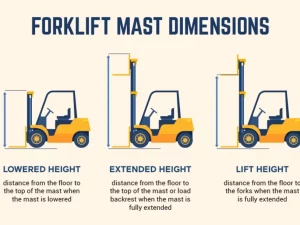
Now determine what is physically the highest point that will pass through the doorway.
On many forklifts, the highest point is the top of the mast assembly when fully lowered. On others, it can be the overhead guard, a work light bracket, a strobe, or a mounted accessory. You should not assume. Walk around the truck and visually confirm the highest fixed point while the mast is fully lowered.
This step matters because warehouse doors rarely fail at the centerline. Most contact happens at an edge: the top corner of the frame, a low-hanging door track, a roll-up drum, or a fire sprinkler pipe that sits just inside the door line.
Measure the forklift’s lowered mast height (what you will compare to the door)
Use a tape measure (or a laser distance meter if you have one), and measure from the floor surface directly up to that highest fixed point. Take the measurement as close as possible to the door approach line—meaning you measure the height the forklift will present to the door, not a theoretical height from a curved or uneven surface.
If your floor has obvious wear, dips, or a sloped apron leading into the door, measure on the most realistic path the forklift takes. If you typically enter at a slight angle because of aisle geometry, measure on that same path and note it. It is better to capture reality than to collect a “perfect” number that will fail in practice.
Write down the final number as your forklift lowered mast height for door clearance. In many spec sheets, you’ll see this described as “overall lowered height” or similar wording.
Measure the warehouse door’s true clear opening height
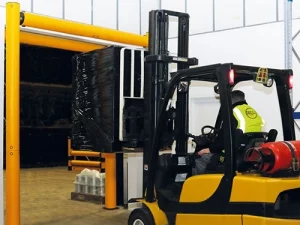
The door measurement must be the clear opening, not what the building drawing says and not the nominal door size.
Stand on the forklift’s approach side and measure from the floor to the lowest obstruction that the truck will pass under. For a roll-up door, this may be the bottom of the door drum housing or the lowest point of the track hardware. For a sectional door, it can be a section edge or a track bracket. For a dock door, it may be the lower edge of a dock shelter header or a protruding seal frame.
If the floor has a raised threshold, a drainage channel, or a metal plate, measure from the highest point the forklift’s tires will ride on when it crosses. If the approach includes a small rise, the forklift effectively becomes taller relative to the opening at that point.
Make the clearance decision using a practical margin
Compare the two numbers: the forklift lowered mast height and the door clear opening height. If they are equal, that is not “safe.” You need a margin for real-world variance: tire pressure, floor unevenness, operator approach, and mast movement.
In day-to-day warehouse operations, a conservative clearance margin reduces downtime and damage. The right margin depends on your floor conditions and your operator discipline, but the decision rule stays the same: you are verifying clearance under operating conditions, not proving it under lab conditions.
If the margin is tight, do not guess. Re-measure in multiple spots across the doorway width (left, center, right), because many doors are not level. Then repeat the forklift measurement on the path the truck actually takes, including any slight slope or turn.
Verify your field measurement against the forklift’s specification sheet
After you have a measured value, cross-check it against the documentation for your exact configuration. The spec sheet value gives you a second reference point and helps detect common errors, such as measuring in the wrong mast posture or forgetting a mounted accessory.
If your field measurement is meaningfully different from the spec sheet, do not average them. Re-check the forklift posture (mast fully lowered, travel tilt), confirm the highest point, and confirm tire condition. If the forklift has different mast options or tire sizes, verify the configuration matches the document used.
If you need to review forklift configurations and mast options available from the manufacturer, you can reference the Forklift product center and match your operating conditions to the correct model and mast arrangement.
Why door clearance measurements go wrong in real warehouses
Most clearance mistakes are not caused by “bad math.” They come from a mismatch between what people measure and what happens in operation.
The first issue is measuring the mast in an unnatural position. A forklift staged for maintenance, photography, or loading may have a different mast tilt than a forklift traveling through a doorway. The second issue is measuring the door opening at the wrong spot. In older buildings, the door frame can sag, tracks can sit low, and the lowest obstruction can be inside the door line rather than at the outer edge.
Another frequent problem is ignoring what changes over time. Tires wear, tire pressure drifts, and floors develop ruts near doors. Those changes can turn a once-safe clearance into a recurring incident. That is why the best measurement method is not “one-and-done.” It is a method you can repeat quickly and verify.
A realistic warehouse example (and what the numbers actually tell you)
Consider a distribution warehouse with a dock door that seems generous. The nominal door is 10 feet high, but the roll-up hardware drops slightly below that. The floor has a mild rise right at the threshold because of a long-lived patch.
An operations manager measures the door at the center and gets a comfortable number. Yet, the forklift occasionally kisses the door track on the right side. When the team measures again, they find the right side obstruction is lower, and the forklift approaches at an angle because the aisle lines up that way. The “centerline measurement” was accurate, but it was not the right measurement for the way the truck actually moves.
In practice, the best measurement is the one that matches the forklift path and the lowest obstruction point. That is what reduces damage, not the prettiest measurement recorded in a notebook.
How forklift design affects clearance and operator confidence
Door clearance is a geometry problem, but it is also an operator confidence problem. If a forklift is loud, harsh, or difficult to control precisely at low speed, operators tend to drift off the ideal approach line. Good visibility and stable low-speed handling help them line up consistently.
Qingdao Hezhong Machinery Manufacturing Co., Ltd. designs forklifts with an ergonomic operating space intended to reduce long-shift fatigue, along with lower noise and vibration characteristics through cushioning and insulation measures. The company also highlights practical durability elements such as a robust integrated frame structure and braking system improvements aimed at controlled handling in demanding material-movement work.
These details are not “marketing extras” in a warehouse. They influence how repeatable your approach to a narrow door opening will be, especially in multi-shift operations where different operators run the same route.
If you are evaluating models for warehouse work, start with your clearance measurements, then compare mast configurations and dimensions against your building constraints. You can review available forklift categories and configurations at the Product Center.
How to confirm you did it right before the next shift
Once you have the measurements, do a controlled verification pass under supervision. Drive slowly, keep the mast fully lowered, and have a spotter watch the highest point relative to the lowest obstruction. If your operation allows it, mark the safest approach lane on the floor so operators follow the same line each time.
Re-check after any of the following: tire replacement, mast service, overhead accessory installation, changes to dock equipment, or door maintenance. A forklift that “used to fit” can become the forklift that creates recurring repairs.
For more operational resources and updates, you can start from the company’s main site at Qingdao Hezhong Machinery Manufacturing Co., Ltd. official website.
About Qingdao Hezhong Machinery Manufacturing Co., Ltd.
Qingdao Hezhong Machinery Manufacturing Co., Ltd. is a machinery manufacturer in China with international cooperation and shared technologies since 2007. The company is located in Pingdu, Qingdao, with more than 50,000 square meters of facilities across three major factories supporting R&D and production, and a workforce of more than 400 employees including engineers focused on innovation in construction machinery. The company reports annual capacity exceeding 15,000 mini wheel loaders and forklifts, produces diesel, gasoline, lithium battery, and LPG forklifts, and supports attachment configurations for different working environments. It also states compliance with internationally required manufacturing standards and quality certifications, including CCC, ISO 9001, ISO 16949, CE, and EGS, and exports to multiple global regions while supporting customization and after-sales service.
To learn more about the company’s background and manufacturing approach, see the About Qingdao Hezhong Machinery.
Conclusion
Measuring forklift mast height for warehouse door clearance is a straightforward task when you treat it like a field verification job, not a paperwork exercise. Set the forklift in a real travel posture, identify the true highest fixed point, measure the forklift’s lowered mast height from the actual driving surface, and measure the door’s lowest real obstruction—not the nominal door size. Then compare the numbers with a practical margin and verify your measurement against the spec sheet for your exact configuration. This approach prevents costly door strikes, reduces downtime, and gives warehouse teams a repeatable way to make “will it fit” decisions with confidence.
FAQs
How do I measure forklift mast height for warehouse door clearance if the floor is uneven?
Measure the forklift on the same path it uses to approach the door, and measure the door opening from the highest point the tires will ride on at the threshold. If the floor has dips or a crowned slab, take readings in more than one spot and use the tightest realistic clearance point, because that is what the forklift will see in operation.
What is the best way to measure forklift mast height for warehouse door clearance when the mast is tilted?
Measure with the mast in the normal travel posture used for driving through doorways. A measurement taken with the mast perfectly vertical may not reflect real operation. If operators use slight rear tilt, measure with that tilt so the height you record matches the forklift’s true clearance requirement.
Why does my forklift still hit the door after I measured mast height and it should fit?
This usually happens when the door was measured at the wrong obstruction point, when the forklift approaches at an angle that puts the highest point under a lower part of the track, or when floor conditions change the relative height at the threshold. Re-measure across the doorway width and repeat the forklift measurement on the actual travel line.
How do I verify my forklift mast height measurement using the spec sheet?
Look for the specification that corresponds to mast height when fully lowered, commonly listed as overall lowered height. Confirm the configuration matches your forklift’s mast type, tire size, and installed accessories. If the spec value and your field value differ meaningfully, repeat the measurement steps with the forklift in true travel posture.
When should I re-measure forklift mast height for warehouse door clearance?
Re-measure whenever something changes that can affect height or approach: new tires, different tire type, mast service, installation of overhead accessories, changes to the door track or dock equipment, or when you move the forklift to a different warehouse with different floor conditions.