



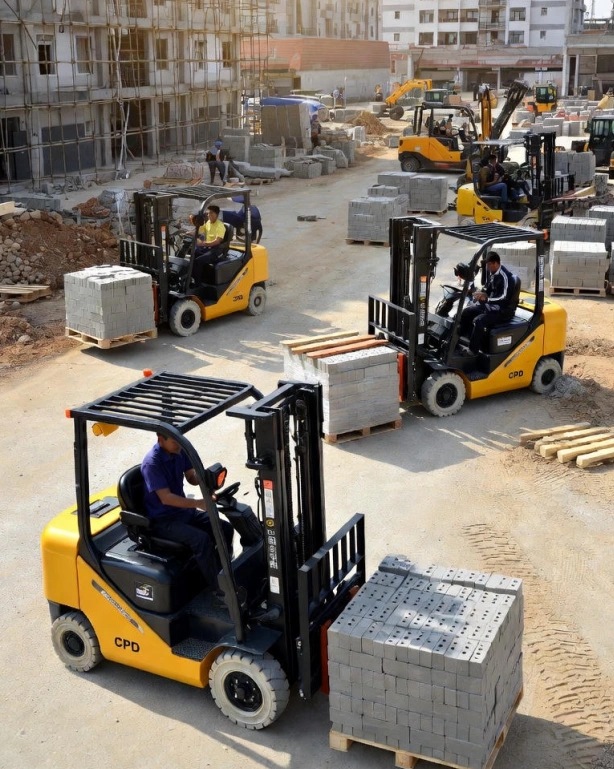
Anyone who has ever managed a busy commercial or civil construction site knows the moment an electric forklift goes into limp mode at 2:30 p.m. because the battery is too hot or simply exhausted. The concrete pump keeps running, the crane operator is on the radio asking where his next load is, and half the crew suddenly has nothing to do. That single event can cost thousands in lost productivity before the day is over. For years, that scenario kept most contractors firmly in the diesel camp when it came to outdoor materials handling. The surprising truth in 2025 is that the scenario is no longer inevitable. A growing number of sites worldwide now run electric forklifts from first light until the end of shift on one charge, or with nothing more than a short lunch-break top-up. The difference comes down to equipment that was actually engineered for construction yards rather than retro-fitted warehouse trucks.
The Gap Between Brochure Numbers and Construction Reality
Manufacturers love to quote “up to 8 hours” of continuous operation. Those figures are almost always measured under EN 16796-1 warehouse duty cycles: flat polished concrete, 25 % load factor, 23 °C ambient, gentle acceleration. Real construction sites laugh at those conditions.
A typical day might include moving 4–6 ton loads of block or bagged material up an 8 % gravel stockpile twenty times an hour. Each climb pulls a 180–220 A current spike from the battery. The descent should return energy via regenerative braking, but many warehouse-tuned controllers are deliberately conservative on regen aggressiveness to protect indoor flooring and reduce brake wear. The result is almost no energy recovered. By noon the pack has already given away the equivalent of two extra hours of runtime that will never come back.
Then the sun comes out. Pack temperatures climb past 45 °C, the battery management system (BMS) starts limiting current to prevent long-term damage, hydraulic pump speed drops, and the truck feels like it is running on three cylinders. Dust from dry soil or concrete batching settles on cooling fins, airflow drops another 15–20 %, and the fans spin faster just to keep up. Suddenly a truck that looked perfect on paper is crawling, and the site superintendent is on the phone asking why he ever believed the electric hype.
What Changed: Engineering That Actually Matches the Job
The latest generation of construction-ready electric forklifts closes that gap through four non-negotiable design choices.
First, battery capacity has moved well beyond the 400–450 Ah packs common in warehouse models. Most serious outdoor units now carry 550–620 Ah lithium packs in the 3–5 ton class, with some 8–10 ton rough-terrain electrics pushing past 800 Ah. Raw capacity alone is not the complete answer, but it provides the buffer needed when regen and thermal limits inevitably bite.
Second, thermal management has become far more robust. Larger heat exchangers, sealed against dust, variable-speed high-volume fans, and liquid-cooled plates in high-end packs keep cell temperatures 8–12 °C lower than air-cooled warehouse designs running side-by-side in the same conditions. Lower average temperature means the BMS rarely needs to intervene with power cuts.
Third, regenerative braking calibration has finally been adjusted for real-world gradients. Modern controllers now allow much higher regen current on downhill runs and during deceleration over rough ground. Independent testing on mixed-terrain cycles shows energy recovery rates of 14–19 % of total consumption, compared with 4–7 % on older warehouse-tuned systems. Over a ten-hour shift that alone can add more than an hour of usable runtime.
Fourth, fast-charge chemistry and onboard charger capability have matured. Packs specifically rated for 1C continuous charging accept 80 % replenishment in 45–60 minutes from a standard 3-phase site supply. That single improvement turns the traditional “one battery per shift” limitation into “one battery per day or even per 16-hour double shift” on many projects.
Documented Full-Day Performance from Active Sites
Late-2024 deliveries to port-adjacent construction projects in Peru provide a clear example. Trucks equipped with 620 Ah lithium packs and enhanced cooling operated in ambient temperatures averaging 32–37 °C across gravel, sand, and temporary road plates. Daily cycles included repeated climbs of 7–9 % stockpiles with 4.5–5.5 ton loads of cement and rebar. Shifts ran 06:00 to 17:30 with only a 50-minute opportunity charge during lunch. No battery swaps were required, hydraulic performance remained consistent through the afternoon, and recorded consumption averaged 58–62 kWh per full shift, well within design parameters.
Similar results have been repeated on large highway projects in northern China through summer 2024, where site temperatures regularly exceeded 38 °C. Operators reported being able to complete scheduled moves without the afternoon slowdown that plagued earlier electric units. Monthly diesel displacement exceeded 9,000 litres per truck, with zero unscheduled downtime attributed to battery or thermal issues.
Site-Level Practices That Add Real-World Hours
Even the best hardware benefits from disciplined habits.
Tire pressure is routinely overlooked, yet running 10–15 psi low on dual-drive tires increases rolling resistance enough to cost 7–10 % range over a shift. A five-minute air check every Monday morning pays for itself many times over.
Routing is equally important. Spending fifteen minutes with a laser level to shave two or three degrees off the steepest regular path can return 5–8 % energy savings that compound daily. Simple shade structures or even parking the truck nose-in to a container during breaks prevents the pack from absorbing direct radiant heat and starting the second half of the shift 6–8 °C cooler.
Driver technique still matters. Smooth progressive acceleration and anticipation of stops recover more energy than aggressive throttle use. Most sites see a noticeable range increase after a single 30-minute driver refresher focused purely on energy management.
Opportunity charging during natural breaks is the single biggest game-changer. A 25–35 minute connection at morning break and again at lunch routinely adds 35–45 % range, enough to push a marginal eight-hour pack into comfortable ten-hour territory without any hardware changes.
The CPD Series: Built for Construction From the Ground Up
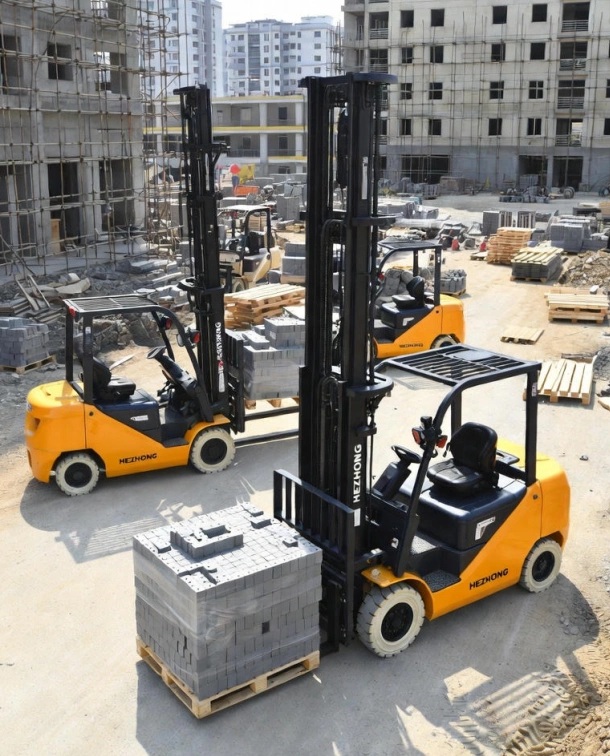
Qingdao Hezhong Machinery’s CPD range of 2.5–10 ton electric forklifts was developed specifically for these outdoor, high-cycle environments. High-capacity lithium batteries are standard across the line, housed in sealed compartments with filtered positive-pressure cooling to combat dust ingress. Liquid-cooled drive motors and controllers further reduce thermal stacking during repeated heavy lifts. Fast-charge profiles are integrated from factory, allowing 0–80 % in approximately 50 minutes on common site power. Enhanced regenerative tuning captures energy across the uneven terrain and gradients typical of construction yards, routinely returning 15–18 % of daily consumption to the pack.
The result is documented single-charge shift lengths of 8–11 hours under real construction loading, with many sites now operating double shifts on a single overnight charge plus one midday top-up.
About Qingdao Hezhong Machinery Manufacturing Co., Ltd.
Established in Qingdao, Shandong Province, Qingdao Hezhong Machinery Manufacturing Co., Ltd. has focused exclusively on material handling equipment for demanding industrial and construction applications. Complete vertical integration, from chassis fabrication to battery system design, allows the company to respond rapidly to site-specific requirements that generic warehouse platforms cannot meet. Recent large electric forklift fleet orders for South American infrastructure and mining-linked projects demonstrate growing international acceptance of this construction-first engineering approach.
Conclusion
The old excuse that electric forklifts cannot survive a full shifts on active construction sites no longer holds water. When battery capacity, thermal design, regenerative efficiency, and charging infrastructure are all addressed with real outdoor cycles in mind, ten reliable hours on a single charge has become the norm rather than the exception. Contractors adopting properly specified machines today are seeing immediate drops in energy cost, noise exposure, and maintenance burden while maintaining or improving materials-flow productivity. The technology has caught up with the job site; the only remaining question is how quickly each operation wants to capture the savings.
FAQs – Electric Forklift Battery Life on Construction Sites
Q: How long can a modern electric forklift realistically last on a single charge in construction work?
A: Current construction-spec models with 550–620 Ah lithium packs routinely deliver 8–11 hours under typical outdoor cycles including slope work and high temperatures.
Q: Is a true 10-hour construction shift possible without battery swapping?
A: Yes, many sites worldwide now complete full 10–11 hour shifts with only a 45–60 minute fast-charge opportunity at lunch.
Q: What drains electric forklift batteries fastest on rough terrain and stockpiles?
A: Repeated high-current incline lifts, elevated pack temperatures, dust-restricted cooling, and low tire pressure are the primary culprits. Modern construction-ready designs mitigate all four.
Q: Can construction-site electric forklifts use fast charging without damaging the battery?
A: When the pack and charger are engineered together for 1C rates, 80 % charge in under an hour is standard and has no measurable effect on cycle life.
Q: How quickly do electric forklifts pay back on a construction project versus diesel?
A: At typical construction utilisation of 1,600–2,200 hours per year, most users recover the purchase premium through energy and maintenance savings within 18–30 months.


