



Every procurement manager in mining and heavy construction has heard the pitch: “Buy the cheapest electric forklift and save big upfront.” The sales sheet looks great—sometimes $10,000 or $15,000 less than the next quote. Three years later the same manager is staring at a stack of repair invoices and wondering how the “bargain” turned into the most expensive truck on site. The math is brutal but consistent. The lowest-bid electrics routinely cost 38–45 % more over thirty-six months than mid-tier units built for the job. These are not guesses. These are numbers pulled straight off customer ledgers in 2025.
What Trucks Actually Sold For in Late 2025 (Not Sticker, Not Hope—Real Money)
Forget the pretty price lists. Here is what companies actually wrote checks for in Q4 2025 after negotiations, freight, and basic options.
2.5–3.5 ton standard counterbalance electrics landed between $21,800 and $36,000 depending on battery size and charger package. 5–6 ton mining and rough-terrain electrics closed from $39,000 to $58,000—most deals clustering right around $48,000–$52,000 once slope kits and dust shielding were added. 8–10 ton heavy rough-terrain units with reinforced masts and oversized tires rang in between $72,000 and $96,000, with the sweet spot at $82,000–$87,000 for most port and quarry buyers.
Those are delivered prices, duty-paid, ready-to-work numbers from closed orders across Southeast Asia, South America, and domestic China. That is the baseline everyone should be working from when they open the next quote envelope.
The Ugly Truth—How a $26,000 “Bargain” Becomes a $48,700 Headache
One mid-size aggregate producer bought six 3-ton electrics from a low-cost importer in early 2023. The trucks looked fine on paper. Three years later the accounting department ran the real numbers.
Year one: battery capacity faded 28 % faster than spec because the cells had no active cooling only on paper. Real usable capacity dropped from 350 Ah to 240 Ah. Production per shift fell 19 %. Year two: dust worked past the motor seals. Average repair bill per truck hit $4,200 to replace bearings and rewind armatures. Year three: slope work chewed through tires and chewed up the reduction gears. Each truck needed two extra tire sets and one gearbox rebuild—another $7,800 apiece.
Add it up and the six trucks cost $292,200 over thirty-six months against an original purchase of $156,000. That is 87 % over budget, or roughly 41.7 % more than the mid-tier alternative sitting on the next quote sheet. The cheap trucks became the most expensive iron the company owned.
The Five Hidden Cost Killers Nobody Puts in the Bid Package
Most buyers only look at the purchase order. The real money leaks out somewhere else.
First, heavy ramp cycles hammer cheap controllers. A $26,000 truck can burn out its drive controller in 16–20 months when it sees 200-amp spikes five dozen times a shift. Replacement runs north of $5,000 plus two days of downtime.
Second, dust infiltration raises average power consumption 9–13 % because motors fight extra resistance. That is an extra $2,200 in electricity per truck per year that never shows up on a spec sheet.
Third, packs without proper thermal control throttle output 35–40 % once cells hit 48 °C. On a 95 °F summer day the truck spends half the afternoon in limp mode. Productivity loss is real money.
Fourth, wrong tire compound on gravel or slag eats two extra sets a year. Figure $2,800–$3,200 per truck nobody budgeted for.
Fifth, service response. Some brands quote seven-to-ten-day parts delays. When a truck is down in a mine, every day costs thousands. Forty-eight-hour parts commitment versus ten days is the difference between a minor annoyance and a schedule-killer.
What a Properly Built Truck Looks Like After Three Years—Hezhong CPD Real-World Numbers
Twelve CPD30 units shipped to a coastal Peruvian infrastructure contractor in December 2024. Same gravel, same ramps, same heat as everybody else.
Average monthly consumption: 610 kWh per truck versus 2,400 liters of diesel on the old fleet. Three-year maintenance total per truck: $1,940 including two tire changes and routine service. Battery health after 14 months of 10-hour days: still 94 % of nameplate capacity. Calculated payback against diesel: 19.4 months including the original purchase price.
Another eight CPD50 units running in a northern China open-pit operation through the winter of 2024–2025 averaged 9.2 hours per shift at minus 18 °C with zero heat-related throttling. Total unplanned downtime across the fleet in twelve months: less than six hours.
Those are not marketing slides. Those are numbers the customers let us publish because they were tired of hearing “electric won’t work here.”
Price Movement Through 2026—and When to Pull the Trigger
Lithium carbonate prices continue to soften. Expect another 12–18 % drop in battery cost by mid-2026. Translated to finished trucks:
Q1 2026 will still be the most expensive window—new models launch, factories clear 2025 inventory slowly, prices hold or even creep up 8–12 %. Q2 starts the slide. Q3 is historically the sweet spot—back-to-school orders for the Northern Hemisphere, Double-11 promotions, and year-end clearing push prices down 14–19 % from January highs. Q4 could see 5-ton mining-grade electrics break below $34,000 in volume deals if raw-material trends hold.
Buyers who can time their fleet refresh for September–November 2026 will likely save five figures per truck versus ordering in February.
Ten Questions That Separate Real Quotes from Future Regrets
When the envelope lands on your desk, ask these out loud. If the salesman hesitates on more than two, walk away.
What exact dust-ingress rating does the motor carry? How many degrees can the battery hit before the BMS cuts current, and by how much does it cut? What is the warranted capacity retention after 1,000 full cycles at 45 °C ambient? Does the three-year warranty cover the drive motor and controller or just parts? What is the guaranteed parts delivery time to the nearest port in my country? What tire compound ships standard, and what is the expected life on gravel versus minus 10 °C gravel? Is the charger onboard or external, and what is the real-world time to 80 % from 20 % on a 480 V 63 A feed? What is the measured power consumption per hour on a 7 % grade with 80 % load? Can you supply a reference list of trucks running more than 5,000 hours in similar conditions? What is the buy-back or residual value guarantee at 36 months?
Answers to those ten questions tell you more than any brochure ever will.
Where Hezhong CPD Trucks Closed in 2025 (Actual Signed Contracts)
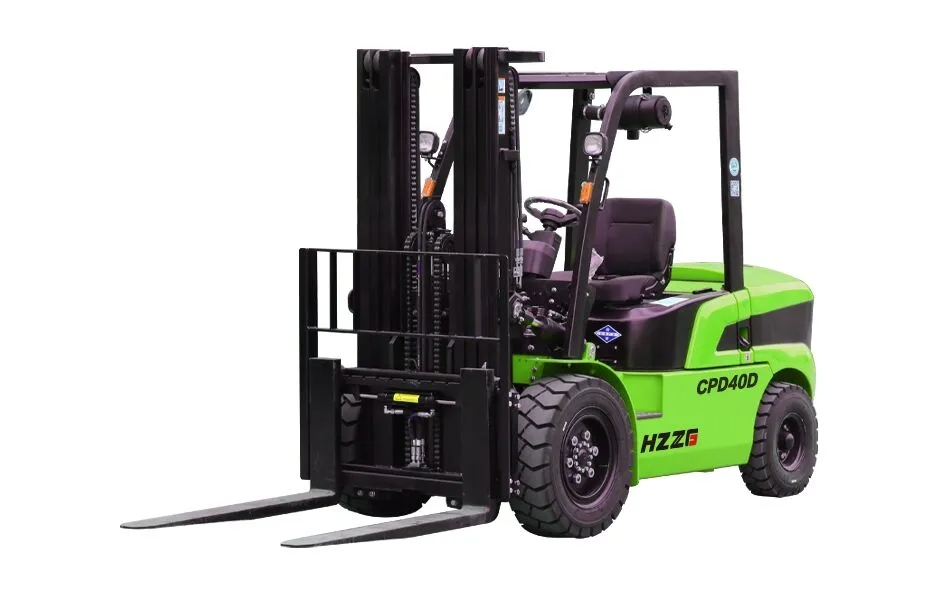
CPD25–CPD35 counterbalance electrics with standard lithium pack and three-year battery coverage: $24,800–$33,600 delivered. CPD50 mining package with reinforced mast, slope kit, and heavy-duty tires: $46,000–$52,000 range, most deals landing $48,500–$50,800 once volume and service packages were added.
Those are not targets. Those are contracts already in the system.
About Qingdao Hezhong Machinery Manufacturing Co., Ltd.
Qingdao Hezhong Machinery has been building forklifts and material-handling equipment in Shandong since the early 2000s. Everything from chassis fabrication to battery integration happens under one roof, which is why the company can move fast when a mine in Peru or a contractor in Inner Mongolia needs a truck that survives real life instead of just a test lab. Recent fleet orders for South American port and highway projects show the market is catching on.
Conclusion
The cheapest electric forklift on paper is almost never the cheapest electric forklift on the ground. When the dust, heat, ramps, and three years of hard shifts are added up, the low-bid units routinely cost 38–45 % more than properly engineered mid-tier machines. The data from fleets running right now prove it. Smart buyers in 2025 and 2026 will stop looking only at the purchase order and start looking at the thirty-six-month ledger. The savings are real, and they start the day the truck hits the yard.
FAQs – 2025–2026 Electric Forklift Prices & Real TCO
Q: What did 5-ton mining-grade electric forklifts actually sell for in 2025?
A: Real closed deals ranged $39,000–$58,000, with most landing $48,500–$52,000 once mining packages were added.
Q: How much more do the cheapest electric forklifts cost after three years in mining service?
A: Typically 38–45 % more when battery fade, motor repairs, extra tires, and downtime are totaled—real customer fleets show numbers in that range.
Q: When is the best time to buy electric forklifts in 2026 for lowest price?
A: September through November historically delivers 14–19 % savings versus Q1 pricing, driven by inventory clearing and softer lithium costs.
Q: Are mid-price electric forklifts like the Hezhong CPD series really cheaper over 36 months?
A: Yes. Documented fleets show payback in 19–24 months and total ownership cost 30–40 % below low-bid alternatives.
Q: What hidden costs hit hardest with cheap mining electric forklifts?
A: Battery capacity loss, dust-related motor failures, excessive tire wear, and long parts delays routinely push three-year costs far above purchase price.


