



Fuel usage is often the primary operating-cost concern that buyers raise before picking a 3.5-ton chariot élévateur diesel. Warehouse supervisors, plant owners, building contractors, equipment vendors, and rental firms all require a clear understanding of whether a forklift will match their daily financial plan. Yet, diesel consumption cannot be shown by a single static number for every job site. The weight of the load, travel distance, lifting frequency, and ground conditions can alter the final outcome. Idle periods, the type of transmission, and operator driving habits also play a huge role. Therefore, a calculation based on actual workload is much more dependable than simply applying a broad industry average to each unique application.
How Much Diesel Can a 3.5-Ton Forklift Use Per Hour?
A forklift seldom runs at the exact same engine load during a full shift. It might transport heavy pallets for a portion of the day. It might travel empty at other moments. It could also stay idling while delivery trucks or manufacturing materials get prepared. These varied working phases naturally lead to varying levels of fuel usage.
Why Is There No Universal Fuel-Consumption Figure?
Two forklifts of the exact same model can show noticeably distinct fuel records. A truck shifting light pallets on flat concrete typically demands less engine power than one hauling solid building materials across bumpy outdoor terrain. Frequent backing up, quick acceleration, and high lifting cycles can boost fuel needs. Ramp driving and long-distance hauling will also push fuel demand higher.
The chosen attachment matters too. A standard fork carriage, side shifter, fork positioner, or any other add-on brings extra weight. This might shift the load center. When the forklift has to work harder to support both the attachment and the cargo, fuel consumption will likely go up.
Idle time represents another key element. A forklift can burn diesel even when it is not doing productive tasks. Because of this, buyers should carefully split total engine hours from actual material-handling hours when they evaluate costs.
What Do the CPCD-35M Specifications Tell Buyers?
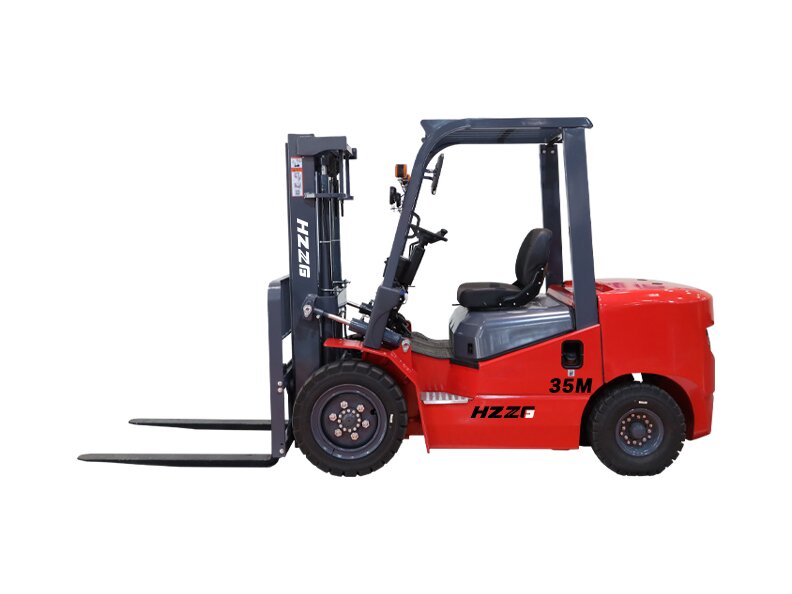
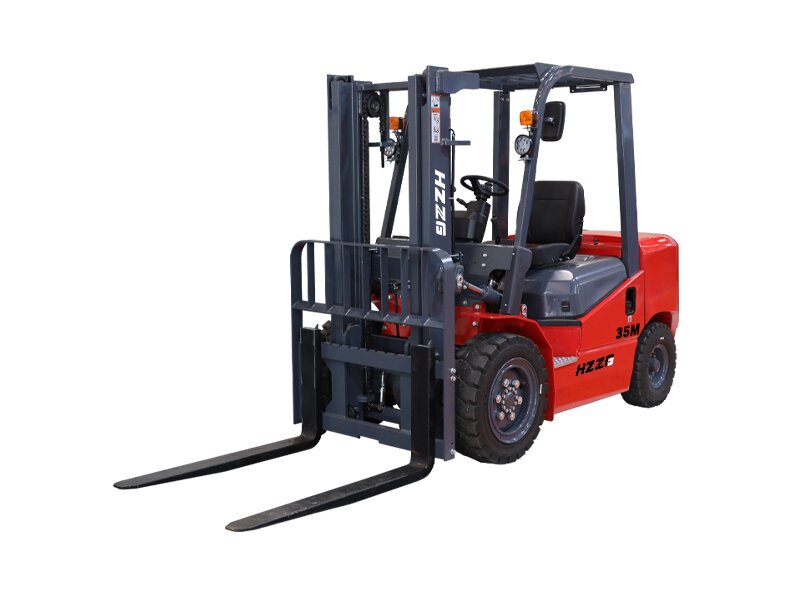
The HZZG CPCD-35M is built to handle 3,500 kg at a 500 mm load center. It features a standard lifting height of 3,000 mm. It comes with a 40 kW XINCHAI C490BPG diesel engine and a 60-liter fuel tank. Buyers can also pick between mechanical and automatic transmission setups.
These technical details help outline the machine’s strength and speed. However, the 60-liter tank does not show exactly how many hours the forklift can run. The total working hours per tank rely on the fuel burned during the customer’s specific daily routine.
How Does Workload Affect Diesel Consumption?
The most sensible way to project fuel usage is to group the application into light, medium, or heavy duty. This method lets buyers weigh fuel costs against real productivity, rather than merely checking engine size or fuel-tank volume.
What Happens During Light-Duty Operation?
Light-duty tasks might involve shifting empty pallets or moving loads far below the forklift’s rated capacity. It often includes driving short distances and doing occasional lifts. This kind of cycle is very common inside small warehouses, packing plants, repair shops, and retail storage zones.
The engine might stay on for several hours, but it does not run at maximum output constantly. Still, fuel efficiency drops when the forklift spends extended periods just idling. Operators should track waiting times apart from active moving times.
How Does Medium-Duty Operation Change Fuel Use?
Medium-duty work generally covers steady pallet handling, constant forward and backward driving, regular lifting, and moderate travel lengths. A forklift might unload trucks and shift materials between assembly areas. It might also restock storage racks and transport finished goods all within a single shift.
For numerous companies, this blended cycle forms the most practical baseline for financial planning. It mirrors the typical mix of lifting, driving, waiting, and turning that happens in a standard workday.
Why Does Heavy-Duty Work Use More Fuel?
Heavy-duty jobs often feature frequent loads right near 3,500 kg, non-stop lifting, rough ground, and sharp ramps. They may require long travel paths or constant use of heavy attachments. Under these tough conditions, the engine has to supply much more power for quick acceleration, hydraulic lifting, and driving.
The CPCD-35M lists a full-load travel speed of 19 km/h and a full-load lifting speed of 330 mm/s. It also boasts a full-load gradeability of 15%. These numbers highlight the machine’s solid working potential. Yet, fuel usage hinges on how often the forklift runs close to these maximum limits.
How Can You Measure Fuel Consumption at Your Worksite?
A basic field test gives a much more precise answer than just copying a liters-per-hour number from a different model or another facility. The test needs to happen during a standard shift. This ensures the outcome captures true loads, travel paths, operator styles, and waiting times.
What Is the Best Testing Method?
Start by filling the fuel tank to a clear, repeatable mark and write down the hour-meter number. Run the forklift through a typical work session, and then fill the tank back to that exact same mark. Finally, divide the volume of diesel added by the total engine hours logged during the test.
The calculation is:
Fuel consumption per hour = Diesel used ÷ Engine hours
For instance, if a forklift burns 16 liters over five engine hours, the measured rate is 3.2 liters per hour. This stands strictly as a math example and should not be viewed as a formal CPCD-35M performance guarantee.
A single test run might be skewed by strange conditions. Therefore, it is wiser to repeat this step across a few normal workdays. The resulting average should include written notes regarding load weight, travel distance, attachment kind, ground surface, and idle periods.
How Can You Calculate Hourly, Daily, and Monthly Fuel Cost?
Once the true fuel-consumption rate is found, it easily converts into a realistic operating budget. The math should rely on the local diesel price and the precise number of engine hours. Avoid assuming that every single paid hour equals a full hour of heavy machine work.
What Is the Basic Fuel-Cost Formula?
The basic formula is:
Hourly fuel cost = Liters consumed per hour × Diesel price per liter
Using a sample rate of 3.2 liters per hour alongside a diesel price of $1.30 per liter, the fuel expense would equal $4.16 per engine hour. If the forklift logs eight engine hours in a day, the projected daily fuel cost reaches $33.28.
Monthly forecasts should look at the actual count of working days. Buyers must also leave room for fuel-price shifts, extra overtime, busy seasonal spikes, and different driver habits.
Should Fuel Cost Be Compared with Productivity?
Looking at fuel consumption alone fails to prove if a forklift runs well. A machine that burns slightly more diesel but finishes notably more loading cycles can actually yield a cheaper cost per pallet.
A useful performance measure is:
Fuel cost per completed cycle = Total fuel cost ÷ Number of completed handling cycles
This specific formula assists fleet managers in judging operators, paths, shifts, and working styles in a much fairer way.
Pourquoi choisir QINGDAO HEZHONG MACHINERY MANUFACTURING CO., LTD.?
Picking a diesel forklift involves more than just checking rated capacity. Buyers also require a vendor that can supply proper setups, attachments, spare parts, and fast technical help.
What Makes HZZG a Reliable Diesel Forklift Supplier?
QINGDAO HEZHONG MACHINERY MANUFACTURING CO., LTD. delivers diesel forklifts, electric forklifts, LPG forklifts, wheel loaders, and material-handling attachments. Its CPCD-35M can be modified to suit various work settings. This covers transmission choices, cabin styles, attachments, and other specific job needs.
Clients can share their normal load weight, lifting height, travel length, surface state, daily running hours, and needed attachments before they buy. This step allows HZZG to suggest a setup that truly fits the actual job, rather than leaning solely on basic nominal capacity.
What Is the Most Reliable Way to Estimate CPCD-35M Fuel Cost?
The most exact fuel-cost guess stems from the customer’s real daily routine. The CPCD-35M features a 3,500 kg rated capacity, a 40 kW diesel engine, and a 60-liter fuel tank. Yet, these specs alone cannot dictate the exact hourly usage.
Buyers ought to test the forklift during standard duties. They should log diesel usage and engine hours, while splitting idle periods from active work. Then, they can compute the cost with the local diesel price. Repeating this test across several days yields a much stronger average for daily, monthly, and yearly budgets.
Questions fréquentes
Does a 60-Liter Fuel Tank Mean the CPCD-35M Can Work for a Full Shift?
Not always. The running time from one single tank hinges on the measured liters burned per hour. The load weight, travel distance, and lifting frequency shape this outcome. Ramps, idle periods, surface conditions, and maintenance levels also dictate how long the fuel will last.
Does Carrying Heavier Material Always Increase Diesel Consumption?
Heavier cargo typically demands more power for speeding up, lifting, and driving. However, the total shift usage also relies on the total cycle count and the amount of idle time. A lightly loaded forklift running without breaks might actually burn more fuel than a heavily loaded unit that only works now and then.
What Information Should Buyers Provide Before Requesting a Fuel-Cost Estimate?
Buyers should offer the average and maximum load weight, along with daily engine hours and the number of handling cycles. They should also share travel distance, lifting height, ground conditions, ramp slopes, and attachment needs. Estimated idle time and the local diesel price are vital too. These facts let the supplier review the application much more precisely.


